
Planning a trip to South Korea involves more than just picking out the best places to visit. Understanding how the local financial system works—and knowing the best ways to pay for things—can save you a significant amount of money and prevent unnecessary stress.
South Korea is highly digitized, and its currency system is efficient, but there are still nuances every traveler should know. Here is your ultimate money guide to South Korea, covering cash, credit cards, currency exchange, and avoiding hidden fees.
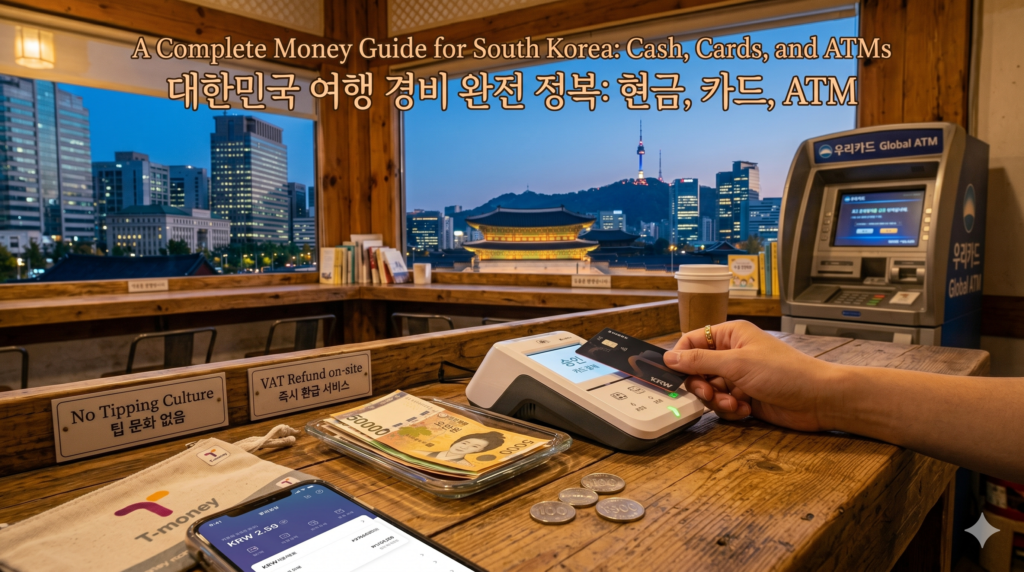
1. The Basics of South Korean Currency (KRW)
The official currency of South Korea is the South Korean Won (KRW), denoted by the symbol ₩.
- Banknotes: Bills come in denominations of ₩1,000 (blue), ₩5,000 (orange/red), ₩10,000 (green), and ₩50,000 (yellow).
- Coins: Coins are circulated in ₩10, ₩50, ₩100, and ₩500.
Because of the many zeros in Korean Won, a quick tip for mental math is to drop three zeros to get a rough estimate in US Dollars (e.g., ₩10,000 is approximately $7.50 to $8.00 USD, depending on current exchange rates).
2. Cashless vs. Cash: What Should You Carry?
South Korea is one of the most cashless societies in the world. You can easily get through most of your trip using only digital payments, but carrying zero cash is still a mistake.
- When to Use Cards: Major credit and debit cards (Visa, Mastercard, and American Express) are accepted everywhere—from luxury department stores to the smallest convenience stores and even inside local taxis. Mobile payments like Apple Pay are also becoming increasingly accepted in major franchises.
- When You ABSOLUTELY Need Cash: You will need physical cash to reload your T-money transit card at subway stations, as these machines do not accept foreign credit cards. Cash is also required when buying street food in markets like Myeongdong or purchasing small souvenirs from traditional stalls.
3. Smart Tips for Currency Exchange and ATMs
To get the most out of your money, avoid exchanging large sums at the airport, where rates are typically the least favorable.
| Method | Where to Go / What to Do | Best For |
| In-City Exchange Booths | Myeongdong or Insadong (Look for high-rated private booths) | Best rates for physical cash exchange |
| Global ATMs | Look for the “Global ATM” logo at major banks (KB, Shinhan, Woori) | Withdrawing cash directly from your home account |
| Travel Cards | Multi-currency cards (e.g., Wise, Revolut) | Striking local transactions without hefty foreign conversion fees |
Important ATM Tip: When using a Global ATM, always check if your home bank charges international withdrawal fees. Additionally, when an ATM or card terminal asks whether you want to be billed in your Home Currency or Local Currency (KRW), always choose Local Currency (KRW). Choosing your home currency triggers Dynamic Currency Conversion (DCC), which adds hidden markup fees.
4. Tipping and Sales Tax (VAT) Refunds
Two financial aspects that surprise many first-time visitors are tipping customs and tax refunds.
- No Tipping Culture: Tipping is non-existent in South Korea. Whether you are at a high-end restaurant, a trendy cafe, or riding a taxi, the price listed on the menu or meter is exactly what you pay. It includes the standard 10% Value Added Tax (VAT).
- Tax Refunds for Tourists: If you spend more than ₩15,000 at a single certified retail store, you are eligible for a VAT refund. Look for stores with a “Tax Free” or “Duty Free” logo. Many major shops can process the refund instantly on-site if you present your passport. Otherwise, save your receipts and claim your refund at the airport before departure.
💡 Conclusion
Navigating money in South Korea is incredibly straightforward once you know the basics. Keep your credit card ready for daily expenses, carry around ₩50,000 to ₩100,000 in cash for transit and street markets, and always decline dynamic currency conversions at ATMs. Financial peace of mind will leave you with more energy to enjoy everything this beautiful country has to offer!